

The polycrisis and the hemispheric crisis: why we can no longer see the whole

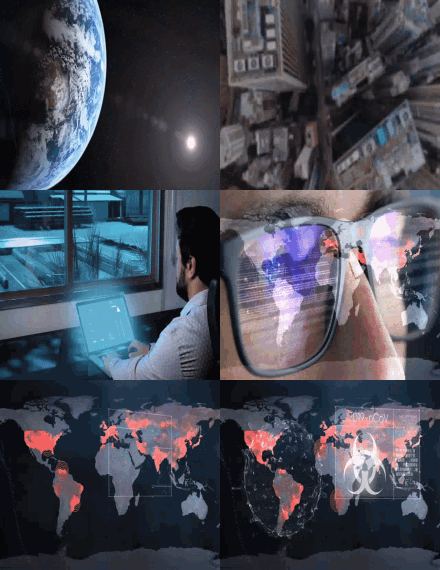
Shall I cheer you up a bit? Humanity is currently in multiple planetary crises simultaneously. The word "crisis" (or even "polycrisis") sounds too sweet when you let the Stockholm Resilience Center's overview from 2025 sink in.

Yes, "we" are in a climate change crisis (global warming). Yes, "we" are in a biointegrity crisis (biodiversity and functional ecosystem degradation). Yes, "we" are in a pollution crisis (far too many artificially produced substances in the environment – plastics and chemical pollution). Yes, "we" are in a land-use crisis (deforestation and urbanization at the expense of natural landscapes). Yes, "we" are in a freshwater crisis (human disturbances of rivers, lakes, seas, and groundwater). Yes, "we" are in a biochemical crisis (large-scale disruption of nitrogen, phosphorus, and other essential nutrient cycles). Yes, "we" are in an ocean acidification cycle (CO2 uptake by the oceans increases ocean acidity and disrupts ocean nutrient cycles). In 2009, "we" as humanity had exceeded two of the seven limits. Barely 16 years later, there are already seven.
I consistently put the word "we" in quotation marks because it is also clear that only a small part of total humanity is responsible for this situation, while the entire human race is indeed experiencing the consequences. In fact, those who have contributed nothing to all this misery often suffer the most. Therefore, there is hardly any "we" on this planet.
That lack of "we" is in turn reflected in the global democracy crisis. Less than 7 percent of the world's population lives in a full democracy, according to the Democracy Index (2024/2025) violence and power crisis. That, too, is a historic low.
The lack of "we" is also reflected in the global violence crisis. Violence against children—the killing and maiming of children worldwide—increased by 31% in 2023 compared to the previous year (consider serious violations in the Palestinian territories, the Democratic Republic of Congo, and Somalia). Sexual violence increased by 25% in 2024 compared to 2023, particularly in conflict zones such as Sudan, Ukraine, and Gaza. Globally, nearly 1 in 3 women will experience physical or sexual violence in her lifetime.
Listed like this, it is not exactly something to be cheerful about. We are molesting the earth, we are fighting each other tooth and nail. And "we" carry on as if nothing is wrong. The aforementioned crises are rarely front-page news. Attention to the climate catastrophe (to single out just one of the crises) has been steadily declining since 2021, while its severity has only increased. Attention to the 6 other planetary transgressions has always lagged far behind in the news regarding climate. And when there is news, a good explanation is almost always lacking.
Is it a strange thought that something common underlies all those crises? My intuition that this must indeed be the case was instantly solidified upon reading "The Matter with Things" by Iain McGilchrist. Yes, there is an underlying crisis: the brain hemisphere crisis of modern man.
With an overwhelmingly rich, scientifically founded substantiation, McGilchrist puts his finger on the very core issue: the imbalance between the way we use our two brain hemispheres. Our left hemisphere is detail-oriented, prefers mechanisms over living beings, and is inclined toward self-interest, whereas the right hemisphere possesses greater breadth, flexibility, and generosity. The imbalance lies in the fact that the left hemisphere, despite its lesser understanding of reality, is increasingly gaining the upper hand in the modern world, with disastrous consequences. People have less and less appreciation, less and less competence, and less and less will and courage to see the bigger picture. They stubbornly continue to focus on details, isolate themselves in silos, and consider their own little domain the most important thing there is. Fewer and fewer people feel responsible for the whole. Every man for himself, no one for us all. Result: as the Western world, "we" are creating an unparalleled polycrisis while simultaneously stubbornly denying it and largely succeeding in ignoring it.
From the moment I was captivated by Iain McGilchrist's books, it became almost impossible not to look at the world through his eyes. In his magnum opus, "The Matter with Things," he argues with great depth, richness, scope, and scientific substantiation that we need both science and intuition, both reason and imagination, to understand ourselves and the world. The most important realization: science and reason on the one hand, and intuition and imagination on the other, are not in conflict with each other, but they cannot exist without one another. The right hemisphere plays a crucial role in making that connection. However, that competence is increasingly less appreciated and even despised. We are becoming increasingly trapped in the (essentially much dumber) 'signature' of the left hemisphere. McGilChrist helps us recognize that signature, in the hope that we can avoid decisions with disastrous consequences.
In my professional practice, together with my colleagues from the City of Rotterdam and TNO, I have been working for a few years now on an extremely powerful yet simple method to restore the balance between the brain hemispheres. The simple summary: ensure that in every conversation and every meeting, zooming out and zooming in are in balance. Zooming out—seeing the big picture—is not a luxury. It is the most urgent cognitive competence of the moment. And it is exactly what I do. In keynotes, masterclasses, and consultancy projects, I help organizations and people recognize the signature of the left brain—and break through it. And to revitalize the power of the right brain. Not as theory. As a movement.
My motto, "Think wider. See sharper. Reach further." is directly derived from the above: thinking wider helps you see sharper and have more far reaching results. We often start by zooming in on fragments without having even a vague idea of the whole. That rarely leads to truly "seeing sharply".
Comments