


RESILIENCE
What keeps a society upright and strengthens it — when the storm rages.
A conceptual and practical framework for what resilience truly requires and must do: four capacities that need each other, and the interconnectedness perspective that makes them work.
CONTENTS
Conceptual framework
THREE — EFFECTIVENESS = SEEING CONNECTIONS
Working framework
FIVE — SIGNIFICANCE FOR CITIES, COLLECTIVES AND INDIVIDUALS
ONE — EXPLORATION OF CONCEPTS
Prepardness, anti-fragility, resilience, recovery,
black swans... how?
There is always a maximum impact that a system can handle. For System Earth, for a society, for a family, for an individual, for a bridge. Above that maximum, it damages, deforms, or breaks, and it comes down to recovery capacity. In English, we call the interplay of durability and recovery capacity resilience.
And that is where the confusion begins. In Dutch policy language, "weerbaarheid" has become the term for what is called resilience in English. But the translation falls short because, strictly speaking, "weerbaarheid" is primarily about increasing the maximum the system can handle. That is not bad—on the contrary, it is essential—but it can never be the only thing. For what happens if that increased maximum is exceeded after all? *Weerbaarheid* alone is like a closed door, a gate, a wall: intended to block out the bad, but always giving way at some point as soon as the pressure becomes too great. And then what? What happens to everything that was supposed to be protected behind that door? How and how quickly can and will you repair the door? How quickly do you get back on your feet? That is what we call "veerkracht" in Dutch (recovery power).
With the concept of antifragility, Nassim Taleb takes a step further. If a system is antifragile, it ensures that with every disturbance it becomes slightly better and/or different so that it is better prepared for the subsequent disturbance—that it has become less fragile. Essential to his approach are black swans: rare, unpredictable events with an enormous impact. His reasoning: a black swan will always occur at a time and place yet unknown, and these black swans are ultimately much more important for the future than all currently reasonably predictable risks combined. While resilience and adaptability primarily depend on competencies such as sharpness, control, and anticipation, we need very different competencies for black swans: razor-sharp intuition, lived experience, street smarts, and ultimate pragmatic realism.
Taleb's thinking is refreshing, but relies heavily on individual competencies. Antifragility as a characteristic of the sovereign actor—who can think, decide, and act under uncertainty. That suits those who only need to stand up for themselves. But humans are by nature eusocial—beings who only become fully human through living together. We do not survive as individuals who hold their own, but as communities that organize their coordination. Our true strength under great pressure is not how each person performs individually, but how well people become attuned to one another precisely when the system comes under strain. We call this collective resilience (in Dutch samenredzaamheid) — the ability of a community to support one another when individual capacity runs out. It is what a street does when the power goes out. What a village does when the harvest fails. What a country does when the norm collapses. And it is precisely where the anti-fragility perspective falls short: regarding what constitutes the collective of people, not what the individual can do.
There is one more reason why samenredzaamheid is not a sympathetic footnote but a systemic necessity — and it comes from an unexpected corner: cybernetics. In 1956, W. Ross Ashby proved that a system can only remain stable if its repertoire of responses is at least as varied as the disturbances it must absorb — the law of requisite variety. Stafford Beer, who translated this law to organisations, drew a sobering conclusion from it: no centre can ever match the variety of its environment. No crisis team, no city hall, no control room. The only way out is to place regulating capacity where the disturbance occurs — distributed, close by, without routing through the centre. That is precisely what collective resilience / samenredzaamheid does. Every street that can catch itself, every neighbourhood that knows what to do when the centre is out of reach, adds regulating capacity that city hall could never have organised. Samenredzaamheid, then, is not only what people owe each other — it is the only place the missing variety can come from.
So what keeps a society standing, and what makes it stronger when a storm arises and rages? Not the anti-fragility of the individual, but the collective resilience of the collective. And for that, you need capabilities on multiple scales simultaneously.
"Wind extinguishes a candle and energizes fire.
Likewise with randomness, uncertainty, chaos:
you want to use them, not hide from them.
You want to be the fire and wish for the wind."
— Nassim Nicholas Taleb, Antifragile
TWO — FOUR CAPABILITIES
Capabilities are essential, their interplay is crucial.
Resilience is not a one-dimensional capacity. It is an interplay of four capacities, each operating at a different moment in time. The figure below summarizes this.

The logic of time
The logic of time
Every crisis has its own logic of time. There is a time before something breaks — during which you can prepare. There is a moment of shock — during which you determine how quickly you get back on your feet. There is a time immediately after the shock — during which you learn what really happened. And there is a longer period after that — during which you fundamentally adjust your system to what you have learned. At each of those moments, a different capacity does the work. Together, they form what resilience can be.
Four definitions
preventing the impact of a crisis
Anticipatory capacity. Focusing on increasing the maximum your system can handle before the shock hits. Reinforcing dikes, rolling out vaccinations, testing regulations, building in redundancy, calculating scenarios. In Rotterdam: the Delta Programme with the Maeslant Barrier as the final piece, the heat plan for vulnerable residents, the cyber resilience of vital infrastructure, the strengthening of foundations in subsidence-prone neighborhoods. Resilience works best when it goes unnoticed — what remains robust due to its presence seems to function naturally.

The ability to recover if a shock does occur
Responsive capacity. How quickly and how well does the system return to functioning after the shock has occurred? Emergency services that are immediately on the scene, emergency shelters that are set up quickly, backup systems that take over automatically, communities that organize themselves without waiting for the government. In Rotterdam: the coordinated COVID approach, the evacuation drills during high water. Resilience is by definition post-shock: it only becomes visible once the event has occurred. And it depends on what you have invested in in the preceding years.

The capacity to learn from a crisis
The capacity for reflection. What does the crisis tell us? Which assumptions turned out to be incorrect? Which signals were missed? Which patterns that we could not see are now visible? Parliamentary inquiries, after-action reviews, lessons from the pandemic, evaluations of disaster response. In Rotterdam: the evaluation of the 2024 AVR fire that showed how a single installation can cripple two vital systems simultaneously, the ongoing reflection on the Rotterdam Weerwoord program, the lessons from the COVID approach that changed the primary care structure. The capacity for learning takes the crisis as a source of knowledge, not merely as an event to move past. What I have seen becoming increasingly clear since 2022: what we are learning is increasingly that the interconnectedness is the problem, not a single isolated system. More on that in the next section.

The capacity to adpat and emerge stronger
The transformative capacity. What we have learned must have an impact. Not as a minor adjustment, but as a fundamental change in how the system works — or even what the system is. Not just raising the dike, but changing the city's relationship to the water. Not just fighting the virus, but reorganizing healthcare. Not just strengthening the network, but rethinking the entire energy system. In Rotterdam: Bospolder-Tussendijken 2028 as an experimental resilience district, the Rotterdam approach to green-blue networks that addresses water, heat, and biodiversity issues in one fell swoop, the gradual transformation of South Rotterdam into a multifaceted city.
Capacity for change is related to Taleb's anti-fragility, but not identical. Anti-fragility becomes stronger *through* every disruption, almost automatically. Capacity for change requires a conscious choice to transform. A community can develop capacity for change without embracing every crisis — and must do so, because not every crisis is a welcome teacher.

Capabilities operate on different scales. Individuals can have competencies, as can communities. Naturally, both types of traits differ from one another. Below is a first overview.
The four capabilities are neither hierarchical nor sequential — they act simultaneously and interact with one another. A system that is merely resilient fails as soon as the shock is unexpectedly large. A system that possesses only resilience continues to repair endlessly without ever improving. A system that learns only cannot process its lessons. A system that changes only does not know its own history. Only when all four have been developed does the trait we call resilience emerge.
But even all four capabilities combined are not enough if they are developed without a view of the bigger picture. More on that below.

THREE — EFFECTIVENESS = SEEING CONNECTIONS
Four levels of capabilities only work from the bigger picture.
The four capabilities from the previous section are not sufficient in isolation. A system can be technically robust, resilient, learning, and changing—and yet fail, because it does not see its environment. Anyone who focuses solely on their own domain misses the cascade coming at them from another domain. Cyber resilience without a geopolitical perspective. Climate adaptation without a health perspective. Energy transition without a social perspective. These capabilities only work effectively when deployed with a view to the bigger picture.
As humanity—and therefore not as a city, region, or country either—we have no shortage of crises: multiple planetary ones (think of climate, biodiversity, resources, and pollution) and multiple socio-economic ones (think of inequality, health, cyber). We find it "comfortable" to address or define these crises as separately as possible—to compartmentalize them, as we do with almost everything. But that is now miles away from reality. A crisis never comes alone: they are often caused by the same causal mechanisms, they reinforce each other mutually, in ways that are unpredictable.
Fossil fuel addiction causes climate change. Climate change puts biodiversity under pressure. Biodiversity loss makes food systems more vulnerable. Food insecurity increases inequality. Inequality fuels populism. Populism undermines governance capacity. Reduced governance capacity slows down climate action. And so the cycle continues, getting bigger each time.
This is what polycrisis is: a network in which every problem can exacerbate all other problems.
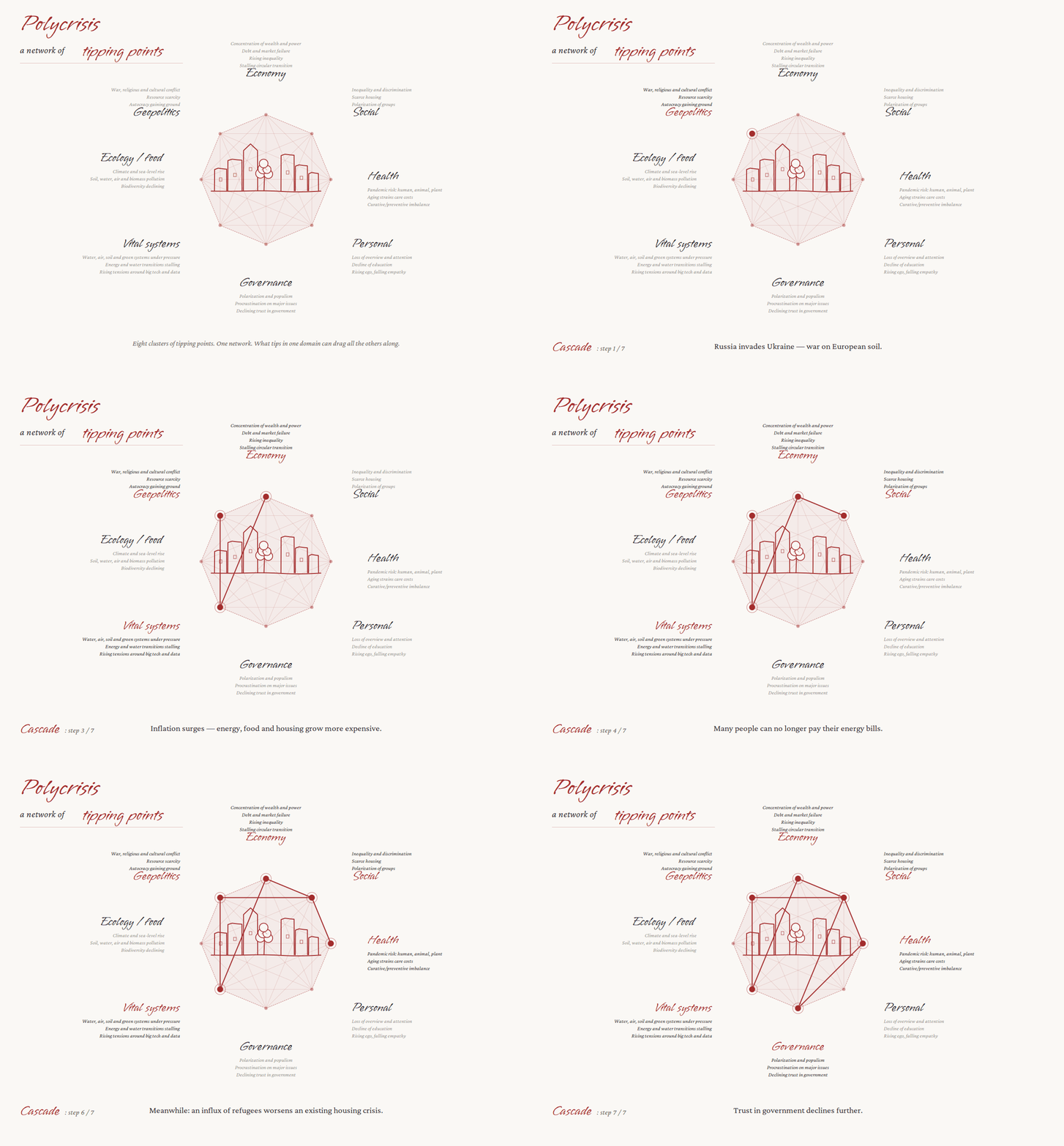
Polycrisis
In this figure — which I have been using in my work for years — you see eight categories of tipping points operating around an urban society. Each is a challenge in itself, together they form a storm whose epicenter no one knows. The red connecting lines between the categories are the essence: they show that a crisis in one domain can trigger a crisis in another — and that resilience thinking must recognize that network to be effective.
The Coherence View
The crucial capacity for our time is therefore not one of the four capabilities separately. It is the interconnectedness perspective that holds them together — the ability to see cross-connections, trace cascade effects, and weigh the contribution of an intervention to the greater whole. An administrator who lacks this cohernce view can manage a crisis well while simultaneously unintentionally causing another crisis. A program manager who focuses only on his own file may appear effective based on his own indicators but prove destructive based on those of others. The coherence view requires something specific: a conceptual framework that visualizes all relevant systems simultaneously, makes their interdependencies visible, and traces the point where every intervention has repercussions. Without such a framework, coherence is merely a non-committal word. With such a framework, it becomes a working tool.
That this is not a rhetorical wish but a hard requirement was proven more than fifty years ago. In 1970, Roger Conant and the same W. Ross Ashby demonstrated mathematically that every good regulator of a system must be a model of that system — known in the literature as the good regulator theorem. Whoever wants to steer a system effectively without a model of that system can, at best, get lucky. Seeing the interconnections is therefore not an administrative virtue one may skip if pressed for time; it is a precondition for effective steering. A city that wants to regulate its vital systems without a model of their interdependencies is not breaking a policy rule — it is violating a theorem.
Vital Systems
This is where my work on vital systems comes in — not as an accidental extension of the resilience work, but as the instrument that makes the interconnectedness perspective possible. The Vital Systems framework visualizes eighteen socio-technical systems, positioned within nature, with two healths (planetary and humanitarian) as emergent outcomes. It shows how systems feed or poison each other, how an intervention in one system has repercussions in another, and how health is not a single variable but an emergent property of the whole.
Resilience without a vital systems perspective is like a doctor treating an organ without seeing the body. Potentially effective on the organ, but never with a view of the patient as a whole. The Vital Systems framework makes the body visible — and thereby the place where resilience work can truly take root.
What does this mean for concrete work? That resilience issues can never be captured in a single department, a single file, or a single discipline. And that the choice between repair and transformation can no longer be made without insight into what triggers the shock elsewhere in the system — or what could have been prevented. The next section deals with this.
FOUR — REPAIR OR CHANGE
What does it really mean to be prepared ?
What does making things truly resilient mean? Most crisis responses I encounter in my work are geared towards repair. Something breaks, and attempts are made to restore it to its original state as quickly as possible. That is a natural reflex: return to the familiar situation, return to a workable state. But it is often not what serves society best.
Spurred on by the war in Ukraine and the sudden power outages throughout Spain and Portugal, earlier cities and organizations in the Netherlands are running through the "prolonged power outage" scenario — 72 hours or more without electricity. It should come as no surprise that we are not prepared for this. Not because we didn't know, but because we are set up for a world where electricity is simply "always just there." Our healthcare, our heating supply, our food chains, our digital infrastructure, our payment systems — everything relies on continuous electricity.
What to do? A first reflex: we need to make the electricity system more resilient. More redundancy, better backup, faster recovery protocols. All good and all necessary. But if you look at it from the perspective of capacity for change, another question arises: what would a city be like where a 72-hour power outage is not a crisis? What does a city look like that continues to function effortlessly without electricity? It might be a little easier to imagine this if you consider that the introduction of electricity into European households did not take place until the decade of 1920-1930. So we have only been living with electricity for a little less than 100 years. A city where communities can support one another, where essential services operate in multiple ways, where dependence on a single central system has been phased out in favor of decentralized alternatives. A city where mutual support forms the first layer of resilience, not the last. That is not a repair. That is designing a different city — and starting without waiting for a disaster.
Here lies the sharpest implication of resilience thinking: by looking at resilience, you see flaws that already exist. The scenario makes visible what would otherwise remain hidden. And that opens up the possibility to change before the price is paid. The change, therefore, should begin long before the actual disaster strikes.
Repair as a reflex is understandable. Repair as a standard response to a crisis is not. Often, it is more logical to bring back something better than what was there—something that not only survives but gains strength during times of turbulence. In Taleb’s words: the difference between the candle and the fire. But that requires knowing what kind of system you want to be before the wind picks up.
It is possible. Two historical cases illustrate what resilience thinking truly entails—not just repair, but transformation of what the system fundamentally does. With the caveat, however, that both examples only got off the ground after enormous disasters... It remains difficult to find good examples of "preventing disasters" through transformative action.
The Delta Plan and what came after. After the North Sea Flood of 1953, the Netherlands could have opted for repair—restoring dikes to their former height. Instead, the country opted for the Delta Plan: a large-scale program to protect large parts of the Southwest against the sea in a different way. Storm surge barriers, dams, a new safety standard. That was already a transformation. But the truly interesting turning point came decades later. From the 1990s onwards, the realization grew that simply raising dikes would not save the situation. The river itself would need to be given more space. Room for the River — a program that actually allowed areas to flood to relieve the pressure on the main rivers — became the second transformation. No longer keeping water out, but deliberately letting water in somewhere. A fundamentally different relationship with water than was unthinkable in 1953.
Post-Sandy New York. When Hurricane Sandy flooded the New York waterfront in 2012, the city faced the same choice. Mayor Bloomberg formulated it immediately:
We can't just rebuild to what was there and hope for the best.
What followed was the Rebuild by Design competition — not a recovery project, but an international design competition that invited teams to deliver fundamental rethinking of the cityfront. The result: projects such as the Big U around Manhattan and the East Side Coastal Resiliency — not walls against the water, but landscaped embankments that combine protection and public space. New York also installed a Chief Resilience Officer, who oversaw approximately $20 billion in climate adaptation investments. The 100 Resilient Cities network that emerged from this brought the thinking to dozens of other cities worldwide.
Both examples teach one thing: transformation is possible, but rarely free. It requires administrative courage, financial investment, a willingness to let go of old paradigms, and the will to ask the right questions before the answers lie in ruins.
For administrators, program managers, and organizational leaders, this has an uncomfortable implication: the most valuable resilience work does not happen *after* a crisis, but *now*. Not in the evaluation reports of past disasters, but in the scenarios for future ones. Not in the repair of what was broken, but in the design choice of which systems you want to strengthen, which you want to transform, and which you want to let go of because they no longer have a place in a changed world.
This is not comfortable work. It requires you to accept loss and transformation simultaneously — that some systems do not need to be preserved, that some problems involve a farewell rather than a solution. But it is the work that resilience thinking truly entails.
What this means for the place where this work lands — for cities, organizations, and leaders who wish to work with this perspective — is discussed below.
FIVE — SIGNIFICANCE FOR CITIES, COLLECTIVES AND INDIVIDUALS
Different realities, different logics – all equally necessary and true.
The conceptual framework from sections 1-4 is universal: four capacities, the interconnectedness perspective, repair or transformation. That seems independent of who does it or where it ends up. In practice, of course, that is not the case at all. The same work lands on three scales, and on each scale in two forms. Six realities that all operate fundamentally differently—have their own logic—but must coexist to have an impact.

The matrix reveals what remains hidden in every other approach. The institutional column is what most policy advisors, consultants, and academics recognize: organizations with a mandate, leaders with position, cities with governance. The emergent column is what remains—and there is much there. Neighborhoods supporting each other when the power goes out. Social movements forming around an acute need. Experts whose authority does not come from their title but from their knowledge. Resilience work takes place in both columns, but the logic is different. Institutional actors work according to structure—process, protocol, calendar. Emergent actors are driven by urgency—what needs to be done now, what cannot wait, what demands action.
Those who work solely for the institutional column miss precisely what is often most powerful under pressure. Those who work solely for the emergent column lack the leverage that formal structures possess. They are not alternatives; they are complementary.
On an urban scale—city and society. Polycrisis level, multi-actor, long horizon. This is where the vital systems perspective lands strongest. You recognize the urban side from institutional work: a municipality designing programs around water, heat, energy transition, and social resilience — initiatives such as Rotterdams Weerwoord and BoTu 2028. The question here is never "how do we solve this crisis," but "what kind of city are we becoming under constant pressure." But that same city also consists of its society — neighborhoods, communities, and informal networks that support one another in ways known to no municipal procedure. In her Nobel Prize-winning work, Elinor Ostrom showed how such communities have sustainably managed their shared resources for centuries through subtle rules known to no legal code. Quarantelli and Solnit showed how communities under shock organize themselves spontaneously, precisely where formal authority fails. A municipality that structures its resilience work solely institutionally misses half of the city — sometimes the half where the real coordinating power lies.
At the collective level — organization and social movement. Finite scope, one system or one focused movement. An organization has governance, hierarchy, and strategy. Issues at this level concern strategic transition, culture, silo thinking, and building learning and change capacity. This is where the competency table from the conceptual framework comes in immediately: an organization can be diagnosed based on the four capabilities, and that opens a conversation that is otherwise rarely held. A social movement operates differently. Coalitions and alliances that come together around an issue have networks rather than a hierarchy; they have no strategic plan, but a shared direction. What a movement requires is not more structure—that would actually cause it to collapse—but better coordination of energy. Sometimes the two hybridize: a climate committee within an organization, or an organization that has grown out of a movement. In such cases, both the institutional and the emergent logic must be respected simultaneously, and that is one of the most difficult forms to work with.
At the individual level—leader and expert. The person as a system. What resilience thinking does here is look in the mirror. For leaders with positional authority—board members, directors, aldermen—it concerns the individual column of the competency table. Especially the capacity for change, which rarely grows naturally and is needed precisely here because a leader without that capacity can only make decisions based on position, rather than on insight. For experts, the challenge is focused differently. Their work consists of seeing what others do not see, and that requires something specific in terms of resilience: how do you maintain your own sharpness when the world around you slips away, and how do you remain publicly credible when your insights are uncomfortable? The individual competencies in the table apply to both, but land differently in a leader than in an expert.
The six cells are not exclusive. An alderman is a leader, but works on behalf of a city, and her effectiveness depends on how much space she creates for society, which is not always visible through her institutional lens. A professor is an expert who is sometimes pushed into a leadership position. An NGO director stands with one foot in her organization and one foot in a movement. The matrix is not a classification system — it is a reading tool that allows you to see in what form an issue presents itself, and what that requires regarding the way in which it is addressed.
The work adapts to the scale and the form. But the forms in which we meet also vary — more on that in the next section.
SIX — FORMS OF COLLABORATION
Various ways to meet.
Six places where the work can land — six ways to shape that work. The match between place and form is not a technical choice problem, but a question about energy.
Different questions require different energy. A municipality that does not yet see that its climate adaptation and its healthcare issues touch upon the same system needs something different than an organization that wants to strengthen its learning capacity after a major setback. A leader who feels his paradigm is constricting needs something different than a coalition gathering around a specific issue. Underlying every question lies its own pace, its own scope, its own type of movement. The working method determines whether that movement gets underway or stalls.

For each working method, a brief in-depth look at what the figure shows.
Keynote. One to one and a half hours, a group, a single train of thought. The keynote works best when the perspective on connections is still missing or just beginning to dawn — when people in an organization or policy field still perceive their own dossier as isolated. A good keynote turns that perception on its head. Not by adding more information, but by making visible once again the structure with which the attendees are already viewing the world. What a keynote does not do is replace a process. Anyone expecting a breakthrough from an hour of stagnation is asking for something the format cannot provide.
Masterclass. Half a day or longer, a group that has already seen something and wants to build on it. Where the keynote opens, the masterclass connects — not by reintroducing the perspective on connections, but by working on the vision that follows from it. Which direction do we choose, which assumptions do we let go of, how do we maintain consistency over the long term? This is where groups take the time to anchor the initial shift. It does not work if the interconnectedness perspective is not yet present — then it becomes a keynote that lasts too long.
Process guidance. Weeks to months, sometimes longer. The question is usually not "solve this problem" but "help us design and sustain a transformation." This is where the competency table comes in immediately: an organization can diagnose itself based on the four capabilities, and the process focuses on the capability that is weakest. Often, that is the capacity for learning or the capacity for change — the two that rarely grow on their own. Process facilitation does not work during acute operational crises. Those require different energy and different work.
Supervision and coaching. For leaders who want to develop their own capacity for change. What happens here is something that rarely gets the time in an organizational process: reflecting on what the leader himself needs to be able to sustain this work. Often, it concerns paradigms that are restrictive — ways of looking at things that once helped but now stand in the way. It works when the leader recognizes this himself. It does not work when the personal conversation actually masks an organizational problem — in that case, the problem calls for a different working method, and supervision is a detour.
Advice and analysis. For issues that first require space for thought before they require action. Scenario work that explores different futures. Polycrisis analyses that show how domains are interconnected. Strategic explorations that keep options open before closing them. What is delivered here is not a plan, but a conceptual framework that can underlie a plan. It does not fit when the organization actually knows what it wants and is only looking for the implementation power — in that case, advice is a lack of hands, not a lack of thinking.
Partners in crime. This is the odd one out, and intentionally so. Like-minded fellow disruptors who want to build something together — a study, an experiment, an initiative — do not require a client-contractor relationship. They require reciprocity. What one contributes in terms of brainpower or reach, the other brings in expertise, network, or platform. Something can emerge here that neither can create alone. What it is not: a disguised request for free consultancy. Reciprocity requires mutuality in value and risk, not just in good intentions.
The six forms are not exclusive. A keynote can usher in process facilitation. A coaching relationship can grow into a partnership. An advisory process can raise questions that a masterclass answers. The match between the request and the form is dynamic — sometimes clear at the first contact, sometimes something that only emerges during an exploratory conversation.
None of these forms begins with a quotation. They all start with a conversation in which the real question is first clarified. More on that in the next section.
SEVEN — HOW COLLABORATION BEGINS
First the question, then the form
A collaboration does not begin with a quote. It begins with a conversation in which the real question is clarified before the form is chosen. The sequence is deliberate: not "what does it cost for what is it," but "unpacking" the question before it is answered.
Here are four moments where we meet. Described phenomenologically—what happens—not as steps you have to take.
First contact. An email, a phone call, a message via LinkedIn. What I hear most clearly in that first signal is the type of question underlying it. "I have a budget of X, do what you do" is different from "I recognize something, there is a question here, can we take a look?". The second is an invitation to think; the first is a procedural request. Both can lead to work, but the first requires more time before anything can be conceived. I usually reply within a few days—no automatic reply, but an honest assessment of whether there is something to discuss and when that conversation can take place.
Exploratory conversation. One or two conversations, sometimes more. Here, the question is unpacked — not the solution. What do we see, what is missing, what is the real question underlying the question asked? Often, something emerges during this conversation that was not yet visible during the initial contact: the question you ask is not always the question your situation poses. This is where my insider-outsider perspective comes to life — looking at what is rarely seen within your own system, because you live inside it.
Proposal. Based on that exploration, I will return: what I see, what I propose, why in this form, and what it costs. No black-box quote with a final amount appearing out of nowhere. A motivated structure — the price is tied to a line of reasoning you can follow, and if you disagree with that reasoning, you can say so. The proposal is not a contract; it is an invitation to make a decision. You may say yes, say no, or explore again.
Work phase. Depending on the format from section 6. A keynote requires a day of preparation and an hour on stage; Process facilitation extends over months; a coaching relationship has its own rhythm. What remains constant in all forms: the perspective on connections is the compass, not the procedure. We monitor whether the work lands where it is supposed to land — and if it starts landing somewhere other than we expected, we dare to talk about it.
Not every exploration leads to collaboration, and that is fine. Sometimes an exploratory conversation is the whole job — a question that becomes clearer simply through the conversation, after which you can move forward without me. Sometimes someone else is the right partner for what your question truly requires. Stating that honestly is part of the work, not a lack of customer friendliness.
Examples show what such a process does in practice.
EIGHT — IN PRACTICE
From stomach ache via Atelier Polycrisis to Studio Ongemak.
Act One — March 2022. A stomach ache conversation.
I am sitting in a small setting with the Municipal Secretary at Rotterdam City Hall. It is early March 2022, a few days after the Russian invasion of Ukraine. I have been invited as a member of the Resilient Rotterdam team. It was supposed to be an informal, feet-on-the-table conversation about what the war means for the city.
The Municipal Secretary sets the tone immediately. "I am not going to put my legs on the table, but my stomach ache." He first names what the real stomach ache is — that of millions of Ukrainians fleeing their country — and deliberately places his own stomach ache beneath it. "Compared to that, our stomach ache is of course very relative: we have to house a great many people in a short time. We can do that. If there is one thing we are good at in Rotterdam, it is rolling up our sleeves for the latest crisis."
But that is exactly where his stomach ache begins. "After all, we already have a housing crisis. We already have a climate crisis. We already have a water challenge of epic proportions. We already have a massive energy transition to deal with. We already have excessive inequality in the city. And I could go on like this for a while. My main point: I don't see my organization knowing how to handle this accumulation of urgencies. We risk focusing every time on what presents itself acutely and then forgetting everything else in the process of addressing that. That simply isn't working anymore." Then comes the sentence that opens the entire afternoon: "I have an even worse stomach ache: I haven't the faintest idea how to change that."
I thank him immediately. "How nice and good that you dare to say that you don't know. Then we can have a good conversation. And rest assured: you are certainly not alone. There are more people inside and outside this organization who have been suffering from this for a long time."
At some point, I make him a proposal. "Is it okay if I go out with your stomach ache, and try to gather inspiration and knowledge everywhere inside and outside the organization, to see if we can get further than just a stomach ache?" His answer comes without hesitation. "That is fine and good. But I am not going to give you an official assignment for it, because then I am almost certain it will fail."
I only fully understood what he was doing with that later. He gave me exactly the freedom the work needed. An official assignment would have activated rules that are not designed for working differently. No assignment meant: all creativity, all networking, all improvisation without the burden of accountability. It was institutional work that was deliberately made emergent.
Act Two — Autumn 2022. Atelier Polycrisis.
In the months that followed, I gathered a small group around me. John, Naomi, Marije, Tanne, Frank — people from different clusters of the municipality who each brought something that the others didn't have. Arnoud, the Chief Resilience Officer, joined as the seventh. We are looking for a place to work that isn't City Hall. It turns out to be a vacant upper floor apartment on Beijerlandselaan in Rotterdam South — a building slated for demolition, with two top floors cold, peeling paint, and drafty. The Real Estate department is arranging the electricity and heating. For us, it is ideal: working on something completely new outside the work environment, something we don't even know yet what or how new it is in the beginning.
We know we are not alone with this request. On September 2, 2022, NRC publishes an article titled "The Great Acceleration: How One Crisis Drives the Next." The word polycrisis appears widely in Dutch media for the first time. From that moment on, our initiative is given a name: Atelier Polycrisis. And we call ourselves crazy ants — after the story by forest ranger Arjan Postma about red wood ants in a nest that ends up in the shade. Most ants work harder and harder, follow their scent trails, and tick off their to-do lists. But there are also scouts. Crazy ants that deviate from the established routes and thereby find new places that the colony needs to survive. They do not persuade by speaking — they carry other ants to the new location one by one, until there is enough enthusiasm and the entire colony follows.
We invite people from all walks of life and professional backgrounds to join us in getting a grip on our inability to deal with poly-crisis situations. A professor at Erasmus University is even writing a column about it. With all the collected input, we are creating a real studio in the rooms of the upstairs building. The intention: to introduce specific situations or issues in each room, get visitors reflecting, and, where possible, get them into action.

On November 24, 2022, we invited the municipal secretary to open Atelier Polycrisis. He was the first visitor and had to set aside at least a full morning or afternoon for it. This is not something you arrange on a single sheet of paper with a simple agenda item. He came by on a Thursday afternoon with two of his closest advisors, immersed himself in our offerings, and went home very enthusiastic. A few weeks later, I received an email from him: he had instructed all corporate directors—the directors directly below him—to come visit us.
In one fell swoop, we had captured the highest layer of our organization. In the months that followed, all directors came by in pairs. They turned out to be fascinating mornings and afternoons. The reactions varied widely. Some were angry and piqued—according to them, we were airing our dirty laundry. At the other end of the spectrum were those who experienced it as a funhouse mirror and wholeheartedly admitted: yes, I am part of this system, and I too contribute to its inertia.
Act three — 2023 to present. Studio Ongemak.
Due to the nature of the things we offered on Beijerlandselaan — and the often uncomfortable reactions people gave to them — our studio changed its name over time. It became Studio Ongemak. Every group that comes by inspires us to adapt and improve our offerings. We learn like crazy ourselves — like crazy ants. John turns out to be a whiz at translating insights into drawings. Marije builds game forms. I translate them into diagrams. A whole range of figures, diagrams, and cartoons emerges. We display them together in one of the rooms under the name Patroonstelling. In the attic, we build a large mural on which we play a transition game.

One of the game formats is the Wheel of Response. We walked around observing various management teams and collected the standard questions that were constantly asked—regardless of the problem. They turn out to boil down to nine avoidance strategies and one good response. The visitor takes on the role of someone visiting a management team to put a problem on the agenda. One minute to explain it. We spin the wheel. The visitor may answer the question that comes out of the wheel. After three spins, a member of the management team looks at their watch and says it is time for the next agenda item—the visitor is shown the door. Some get angry about it, others laugh and admit that they do this themselves as well. What the wheel does is make something unbroken visible: in almost every Dutch management team there is one response that would help the organization move forward—"This gives me a stomach ache. How do you see this? I am listening"—and that is exactly the response the municipal secretary chose in March 2022. A diagnostic instrument that honors its own origins under the name Pattern Theory. In the attic, we are building a large mural on which we play a transition game.

Another poster starts small, with the ten most used management tools in our organization: separating, zooming in, focusing, looking back, restricting, avoiding tension, only this generation, forcing choices, only my interest, shielding. Only later—after reading Iain McGilchrist's *The Master and His Emissary*—do we realize that these are precisely the competencies of what McGilchrist calls the left brain hemisphere: detail, control, classification, abstraction. We place ten right-brain competencies alongside them: connecting, zooming out, multifocus, looking ahead, networking, seeking tension, bringing future generations along, adaptive organizing, seeking our interest, letting things in. The poster becomes the compass with which we test whether an organization thinks only from the left hemisphere, or has also allowed the right one in.
What happens next is done by the work itself. Directors share their experiences within their silos. People start emailing and calling unsolicited, asking if they too can come with a group sometime. In 2023 and 2024, we hosted groups on Beijerlandselaan and even held a session with forty interim managers at a different location. Later, it turned out that visitors had started working on initiatives themselves. One of these is now called Mycelium — a completely informal network that occasionally organizes meetings purely to bring people together. A group of young civil servants now also calls themselves crazy ants. The work travels without us having to carry it.
Meanwhile, a new focus emerges within the core group. Marije and I find common ground around the issue of vital systems — the eighteen socio-technical systems that together support a city, and of which we are seeing increasingly clearly how they feed or poison one another. We succeed in getting this onto the civil service agenda, and eventually a Director of Vital Systems is even appointed. At the same time, we use the tools we discovered in Studio Ongemak to apply them to the field itself. The first expert meetings begin in 2023. The zoom-out and zoom-in methodology becomes the working principle. The experts are becoming motivated; to this day, they meet for three hours every two weeks to work on cases. The program has since been adopted by Amsterdam, Utrecht, and Nijmegen.
What remained and what did not.
Not everything we started is still alive.
We had plans to expand Studio Ongemak to other demolition buildings in the city — several uncomfortable places where the work could land. That never happened. We were drawn in so enthusiastically by the implementation of vital systems that Studio Ongemak itself withered away. We still use the building on Beijerlandselaan occasionally — for moments that require different settings and input. But as an experimental studio, it has done its job.
Of the seven original initiators, four are still active: John, Marije, Frank, and I have been carrying the Vital Systems program for three years. Tanne is now a policy advisor for the Resilience program — we are working together a lot again. Naomi has moved to Arnhem and is taking the work with her there in her new role. Arnoud was the least essential in the group and has left the municipality. The work that began in March 2022 with a single stomach-ache conversation is now spread across four cities, an informal network, a formal program, and a group of young civil servants who have started calling themselves crazy ants — without asking our permission to do so. Exactly as it should be.
What keeps a society afloat and strengthens it when the storm rages is not what one person can do, nor what one organization can do. It is what a collective of people learns to bear, precisely when individual capacity runs out. The storm is waiting. So are we.